Roblox doesn’t ship patch notes the way a single game does — there’s no version number you download once a month. Instead, the platform pushes changes continuously, and Roblox’s own Developer Forum posts a running “Weekly Recap” of what actually shipped. If you’re a player, most of this happens invisibly. If you build on Roblox, several of the last six weeks’ changes are things you need to act on before a deadline. This roundup covers both angles: what changed from mid-June through the end of July 2026, and — more importantly — what’s about to break if you ignore it.
Two items here aren’t optional reading if you maintain a live Roblox experience: an API field disappearing on August 6, and a property that gets removed outright in November. Both are covered in detail below, with dates, not vague warnings.
Confirmed: according to Roblox’s Developer Forum, the GetUser API stops returning user descriptions starting August 6, 2026, with full rollout by August 31, 2026. Any experience reading that field needs a fix before then.
Roblox update timeline: mid-June to July 31, 2026
| Week | Headline change | Category |
|---|---|---|
| Mid-June 2026 | Studio Script Sync full release, Roblox Kids and Select global launch | Studio tools / policy |
| July 13–17, 2026 | Animation Graphs full release, Data Stores jump to 500 MB | Creator tools / infrastructure |
| July 27–31, 2026 | Predictive Streaming, Server History, Ads Manager API | Performance / monetization |
Studio and creator tools: the biggest functional upgrades
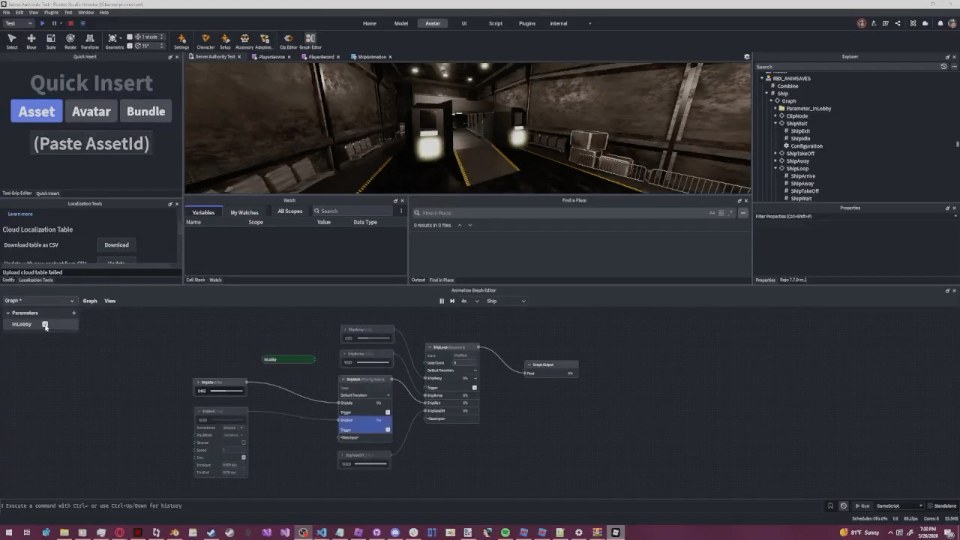
Animation Graphs hitting full release on July 13 is the single most significant creator-tool change in this window. It’s a visual, node-based system for building character motion inside Studio’s Avatar tab, and Roblox says it’s shipped with automatic replication built in and 280+ bug fixes closed out since the beta — that’s a meaningfully long beta tail, which usually signals the team was actively hardening it against real production use rather than shipping on a calendar deadline. For anyone still hand-scripting animation state machines, this closes a real gap with dedicated game engines.
Sitting alongside it: an Input Action Manager beta for building cross-platform control schemes visually, a Studio Camera Navigation beta that collapses camera behavior into just two clear modes (FPS and Focus), and — for anyone scripting outside Studio’s own editor — official Studio CLI documentation with a new --task RunScript flag for running Luau from the command line. None of these are flashy on their own, but together they read as Roblox investing in the parts of the workflow that don’t show up in a trailer: debugging, automation, and getting large teams working without stepping on each other.
Data, performance, and what players will actually notice
Predictive Streaming is the one change here that’s aimed squarely at the player experience rather than the creator’s toolbox. It works by proactively loading areas a player is likely to walk into next, which — if it performs the way Roblox describes — should cut down on the pop-in and mid-walk stutter that’s been a long-running complaint in larger, streaming-heavy worlds. It’s opt-in per experience via Workspace.PredictiveStreamingMode, so don’t expect every game to have it enabled immediately; adoption will depend on individual developers flipping the setting and testing it against their own maps.
On the infrastructure side, Data Stores got a real capacity upgrade: the per-experience storage ceiling jumped from 100 MB to 500 MB, and request budgets were unified across in-game and Open Cloud API calls under a shared 300-request baseline. That storage bump specifically matters for any experience that’s been hitting save-data limits — inventory-heavy games, large persistent worlds, anything storing detailed player history. Combined with the new Client CPU Time Analytics graph (which breaks usage down by Scripts, Networking, Physics, Animation, and Misc), Roblox is giving larger studios noticeably better visibility into where their performance budget is actually going, rather than guessing.

Server History, added the week of July 27, rounds this out — a 30-day window into which servers shut down, crashed, restarted, or ran out of memory, viewable from Creator Hub or pulled via the Open Cloud API. That’s a genuinely useful debugging tool that Roblox developers have wanted for a while; before this, diagnosing a wave of server crashes meant piecing together player reports after the fact.
Monetization and discovery changes
A few changes here shift how money and visibility flow on the platform. The Ads Manager API is now open on Open Cloud, letting larger studios manage ad campaigns programmatically instead of through the manual dashboard — a clear signal Roblox is treating in-platform advertising as infrastructure, not just a UI feature. Music licensing also expanded: creator-uploaded songs now show up directly on game details pages, and the Too Lost catalog — described as thousands of independent tracks — is now browsable in the Creator Store, giving smaller creators a much bigger legal music pool than before.
On discovery, the Home Feed change lets gameplay videos autoplay directly inside the Recommended For You section, and Roblox’s own reported testing showed up to a 39% playtime increase from it. That’s a big enough number that if it holds up at scale, expect more creators to prioritize producing short gameplay clips specifically for that surface rather than treating video as an afterthought.
Two deadlines creators need to act on now
Confirmed: the GetUser API will stop returning user descriptions starting August 6, 2026, with full rollout by August 31. If any of your scripts or backend tooling reads that field — for moderation, profile display, or anything else — it needs to handle a missing value before that window closes.
Confirmed: StarterGui.ClipsDescendantsSupportsRotation is opt-in today but becomes the default behavior in August 2026, and the property itself is removed entirely in November 2026. If your UI relies on the old clipping behavior for rotated elements, test against the new default now rather than discovering the break in August.
Both of these are the kind of change that’s easy to miss in a long weekly recap post but expensive to discover in production. If you run a live Roblox experience with any custom UI or user-profile logic, this is worth a five-minute audit today rather than a scramble in September.
Smaller policy changes worth knowing
A handful of other changes shifted the economics and eligibility rules around the platform. The Highly Engaged Player threshold for Roblox Kids and Select dropped from 100 to 25 players over 60 days, which opens that program to a much wider range of smaller experiences than before. Avatar item publishing costs adjusted to a flat 80 Robux per item for both 2D and 3D assets, addressing what Roblox described as creator feedback about financial barriers to publishing. And Roblox Plus subscribers lose unlimited free private servers starting September 24 — capped at one free server per game going forward, a change Roblox attributed to a small number of Plus members spinning up thousands of free servers.
Animation Graphs in depth: what the node library actually gives you
Animation Graphs reached full release on 15 July 2026, and the headline is easy to under-read. This is not a new animation format. It is a node-based state machine that moves character motion logic out of scripts and into a visual graph, which changes who on a team can own that logic at all.
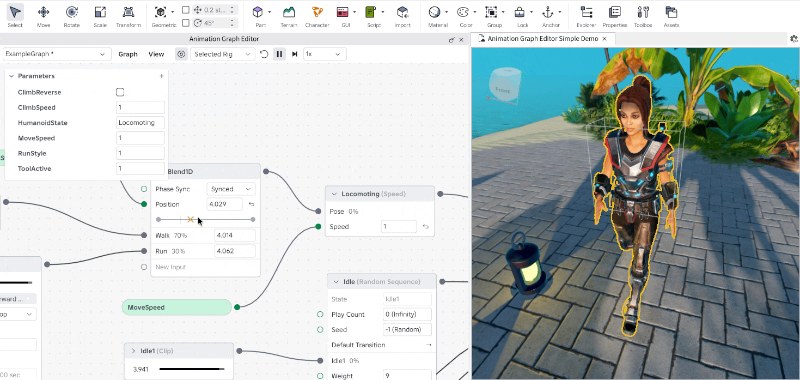
The node library covers the primitives you would otherwise hand-roll. Clip and Sequence handle playback. Blend1D and Blend2D blend across one or two coordinate dimensions, which is how you get a single graph covering idle through walk through sprint, or a movement blend space that responds to both speed and direction. Select and Priority Select switch between states. Mask isolates specific bones, so an upper-body reload can play over a lower-body sprint without either fighting the other. Over, Add and Subtract layer motion and apply mathematical offsets on top.
Parameters are what connect all of that back to gameplay. They come in Number, String, Boolean and Enum types, and a script sets a parameter rather than driving animation tracks directly. That inversion is the actual win here: your combat script stops knowing about animation state transitions and starts publishing facts about the world, while the graph decides what those facts look like on a rig.
What changed coming out of beta
Roblox shipped over 280 improvements and bug fixes between beta and full release, and two of them matter more than the rest.
In-game playback is the first. During beta, graphs ran in Studio only, which made the feature a prototyping toy rather than something you could ship. Running in live experiences is what promotes it to production infrastructure.
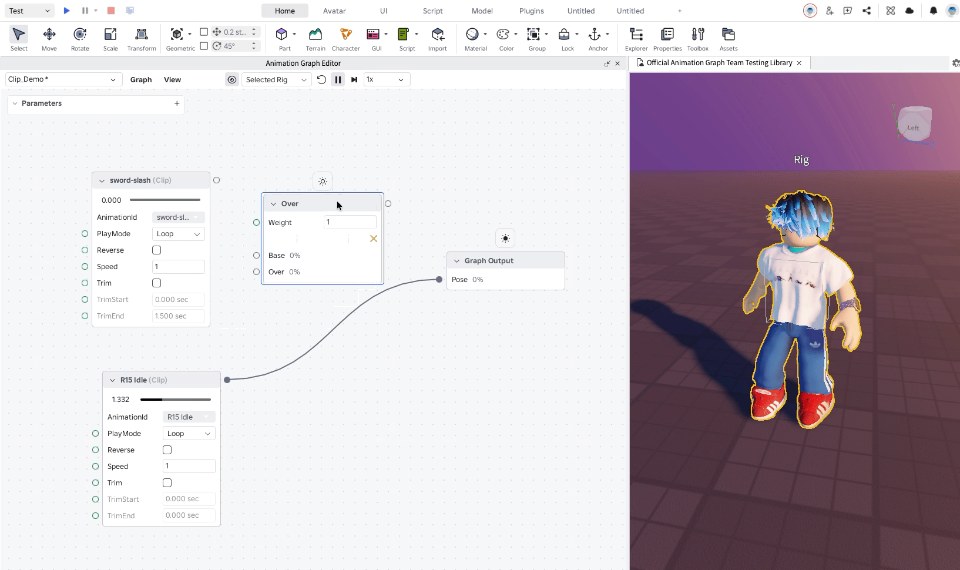
Real-time debugging with node visualisation is the second, and it is the one that will quietly save the most hours. Animation bugs are miserable to diagnose precisely because the failure is visual and the cause is in state you cannot see. Watching which node is active while the character does the wrong thing collapses that gap.
The rest of the list is the unglamorous work that decides whether a tool gets adopted: copy and paste for nodes, drag-to-insert, a faster-opening editor, phase sync on Blend1D and Blend2D, better Team Create collaboration with pin replication, and automatic graph and parameter replication in both Server and non-Server Authority modes. Fixed bugs included masks breaking on names containing spaces, Sequence node failures, AnimationTrack marker signals, and NaN crashes.
What is not there yet: IK and procedural nodes are planned but unshipped, and creators working on large projects have asked for nested sub-graphs and organisation tools that do not exist. If your character system depends on foot placement or procedural aim offsets, this release does not replace your scripting yet.
Predictive Streaming: one property, real frame-time consequences
Predictive Streaming is opt-in and enabled by setting Workspace.PredictiveStreamingMode to Enabled. It uses engine signals to guess which areas a player is about to need and streams them ahead of time, instead of loading reactively when the player arrives.
The reason to care is that the failure mode it targets is the worst kind. Instance Streaming already keeps memory under control on large maps, but the cost shows up as a hitch or a pop-in at exactly the moment a player crosses into new territory, which is usually the moment they are moving fastest and paying most attention. Prefetching moves that work earlier, when there is slack.
Opt-in is the right call and also a warning. Prediction that guesses wrong spends bandwidth and memory on areas nobody visits, so a map with genuinely unpredictable movement, teleport-heavy traversal or dense hub areas may see no benefit. Test it against your own telemetry rather than enabling it because it is new.
Server History and performance alerts: observability catches up
Server History gives 30 days of visibility into servers that shut down, crashed, restarted or ran out of memory, alongside active ones, reachable through Creator Hub under Server Management or via the Open Cloud API.
Before this, a crashed server was largely a rumour: players reported being dropped and there was no authoritative record to check the claim against. Thirty days of retained history turns “some people got kicked last weekend” into something you can look up, and separating out-of-memory from crash from restart tells you which of three very different bugs you have.
Real-Time Performance Alerts extend the same idea forward in time and are now open to every creator with 100 or more daily active users, with custom thresholds, severity levels and webhook delivery. Webhooks are the important part: alerts that reach the Discord or on-call tooling a team already uses get acted on, and alerts that live in a dashboard nobody opens do not.
Music Library, ads API and Studio quality of life
The Music Library launch puts creator-uploaded songs on experience detail pages and adds the Too Lost catalogue, thousands of independent tracks, to the Creator Store. Players can discover and preview privately uploaded music. For creators this is a licensing shortcut more than a feature, since the hard part of shipping music in an experience has always been rights rather than playback.
The Ads Manager API is in testing on Open Cloud for programmatic campaign management, which matters to anyone running acquisition spend at a scale where clicking through a dashboard stops being viable.
On the Studio side: the camera navigation beta refresh adds explicit FPS and Focus modes with a better viewport toggle, /generate_mesh and /generate_procedural_model now show four previews before you commit to a generation, config changes deploy instantly with Publish As copying between experiences and Script Editor autocomplete, and a new Generation Services graph in Analytics tracks generation requests.
The GetUser deprecation is the one with a deadline
Confirmed: the GetUser API deprecation begins 6 August 2026 with full rollout by 31 August 2026, after which it stops returning user descriptions.
Everything else in this recap is something you can adopt at your own pace. This one breaks code on a schedule. If any part of your experience reads a user description through GetUser, whether for profile display, a moderation check or a bio-driven feature, it stops receiving that field within the month.
Worth noting how the rollout is shaped: a 6 August start with completion by 31 August means there is a window where the behaviour differs between servers, so a bug that reproduces for some players and not others during August has an obvious first suspect.
Official Recap Log — Roblox Developer Forum, July 27–31, 2026
The following is reproduced from Roblox’s official Weekly Recap for reference. This section is a citation, not original analysis — see the sections above for that.
- Ads Manager API opened on Open Cloud for programmatic ad campaign management
- Studio Camera Navigation Beta: FPS and Focus modes, toggle in viewport
- Server History in Server Management: 30-day visibility into active/shutdown/crashed/restarted servers
- Predictive Streaming via Workspace.PredictiveStreamingMode
- Creator-uploaded music on game details pages; Too Lost catalog added to Creator Store
- Image previews for /generate_mesh and /generate_procedural_model (4 options, Studio Beta Settings)
- Config improvements: instant deployment, “Publish As,” Script Editor autocomplete
- Generation Services Analytics tab added under Monitoring
- GetUser API stops returning user descriptions Aug 6, 2026 (full rollout Aug 31)
- Real-Time Performance Alerts with webhook delivery (100+ DAU experiences)
- Roblox Plus App Themes: 10+ launch themes
- Home Feed videos autoplay in Recommended For You (up to 39% playtime increase in testing)
- Styling Transitions reached Full Release
- Roblox Innovation Awards 2026 community voting opened
FAQ
Does Roblox have version numbers like other games?
Not in the traditional sense. Roblox ships continuous updates to its engine and Studio rather than discrete numbered patches, which is why Roblox’s own Developer Forum documents changes as dated “Weekly Recap” posts instead of a version changelog.
What happens if I don’t fix my GetUser API calls before August 6?
Your experience will simply stop receiving the user description field in the response — Roblox hasn’t described this as causing errors outright, but any code assuming that field exists will need a null check or fallback to avoid breaking.
Is Predictive Streaming on by default?
No — it’s opt-in per experience through the Workspace.PredictiveStreamingMode property, so individual games need to enable and test it.
When does the private server change actually take effect?
September 24, 2026. Until then, Roblox Plus subscribers retain the existing unlimited free private server allowance.
Editorial note: this article is based on Roblox’s officially published Developer Forum recaps, not hands-on Studio testing of every beta feature listed — betas and opt-in features are described as Roblox has documented them, not independently verified in a live project.
Sources & references
- Roblox Developer Forum — Weekly Recap: July 27–31, 2026 (official)
- Roblox Developer Forum — [Full Release] Animation Graphs (official)
- Roblox Developer Forum — Introducing Predictive Streaming (official)
- Roblox Developer Forum — Weekly Recap: July 13–17, 2026 (official)
- Roblox Developer Forum — Announcements index
Studio screenshots are the property of Roblox Corporation and are used here for editorial commentary and identification. PatchNoteHub is an independent site and is not affiliated with or endorsed by Roblox Corporation. Roblox is a trademark of Roblox Corporation.